
Pilgrimage in Kirecburnu: A Digital Ethnographic Approach
This brief research paper aims to analyse the media pilgrimage from this perspective with the case study of a former Turkish TV-series Leyla ile Mecnun (2011-2013), adopting a digital ethnographical approach over the 4 main settings which are located closely within the same district.
Throughout the history of cinema and television, it is seen that fictional productions such as films and the TV series may influence their audience in a way of an emotional connection between both parties, in which one or more elements of the film (such as characters, items, places, phrases, etc.) become attractive to the audience. Affection to these elements may occur in various ways: Idolisation of actors, imitating the characters in costume/image or attitude, commoditisation of items that are mentioned or used in the film, etc. In case the attraction originates from the places where the film is shot, or, at least, in which the story is set, visiting these actual sites is the behaviour that complements this affection. Such visits have many similarities to the pilgrimage as an ancient, religious tradition of travels. As seen from the subjects of the studies, such as Monthy Python and the Holy Grail (1975) (Beeton 2005), The Inspector Morse (1987-1993) (Reijnders 2010), and Notting Hill (1999) (Busby & Klug 2001), the modern pilgrimage of the audiences is not a new behaviour. Such examples can make us observe an initiative that commercially or voluntarily brings and organises people to travel to the film sites. This is advertised or featured in the media so that people could be aware of it before the participatory evolution of the internet, which can also be called “Web 2.0” (Jenkins et al. 2013). While the tours to the film sites and the touristic value added to these places are not new concepts, so is the “media pilgrimage” (Couldry 2003), the new thing after the Web 2.0 is that there are new ways to explore the film tourism. A new perspective of media pilgrimage is available: a bottom-up, independent, and individual movement of people who plan their route themselves and express their experiences in their own communication channels (blogs, forums, social media, and more recently, vlogs). This is a different perspective than the previously established tours. Therefore, this brief research paper aims to analyse the media pilgrimage from this perspective with the case study of a former Turkish TV-series Leyla ile Mecnun (2011-2013), adopting a digital ethnographical approach over the 4 main settings which are located closely within the same district. This paper also aims to find answers to the question how the contemporary media pilgrimage can differ from that of the earlier decades.
Theoretical Background: Media Pilgrimage and Digital Ethnography
We find the tourism scholars have shown interest in media upon reading the anthological “The SAGE Handbook of Tourism Studies” (Jamal & Robinson 2009). May it be the discourses found in the promotional materials, or the effect of media on people’s personalities and understandings, which finally affects their behaviours as tourists (Long & Robinson 2009), visiting the places that are used as a film recording set has also become a phenomenon wealthy of instances and examples, both on global and local scale. One can find that this phenomenon is called as “film-induced” or “movie-induced” tourism (Riley et al. 1998; Beeton 2005; Busby & Klug 2001), whereas Stijn Reijnders (2010) heavily uses the term “media pilgrimage” in his analysis of three tours conducted in the cities such as Amsterdam, Ystad (of Sweden), and Oxford in favour of TV series Baantjer, Inspector Morse, and Wallander, respectively. Reijnders’ criticism to the earlier studies about the “media pilgrimage” is the frequent emphasis on “the motivation and actions of the fan as tourist”. He rather finds the relationship between the fans’ actions and the setting unaddressed and thus more important to question. Therefore, he suggests a term lieux d’imagination (places of imagination), which is built on the concept of lieux de memoire (places of memory) by Pierre Nora, and explains the findings from the interviews he conducted about the cases in Amsterdam, Ystad, and Oxford. According to this terminology, people are in search of physical reference points to their imaginations, similar to Nora’s explanation of the Western obsession with the past that brings a culture of memorialisation (Reijnders 2010:39).
While Reijnders’ approach is central to our research as he emphasises the places in his work, discussions on the analogy of pilgrim remain essential. What the modern traveller does is seen similar to a role of a religious pilgrim, in their motivation of searching for authenticity and reaffirmations of their beliefs while being social with the people who share the same feeling and pursuit (Beeton 2005). Beeton suggests that the travelling to the filming places are considered “sacred” due to the fame and fantasy. In these sacred places, actions and reactions of a film tourist are similar to that of a religious pilgrim:
Film tourists collect memorabilia of places, actors and characters, taking them home along with stories of fame that raise them up in the view of their peers. The intimate reaction of visitors to many sites can be highly emotionally charged, verging on the spiritual and mystical. (Beeton, 2005: 35)
With such reactions in mind, the film travellers are expected to behave in a way that is associated with a ritualistic manner, as Couldry (2003: 86) does. Our observations in these travellers performing actions such as wearing certain uniforms or signs about the film, repeating and making pun of the lines from the characters, and likely, reanimating the regular gestures during their visit to the site can then be evaluated within the framework of media pilgrimage and ritual practice.
Our study relates to the “places of imagination” from perspective of a rather different setting than that of Reijnders (2010), in which the visits are individually arbitrary rather than organised by tourism entrepreneurs or volunteers. Therefore, information related to these visits highly relies on the narrated experiences of individuals. Pursuing for this kind of information is ethnographic in terms of O’Reilly’s (2005: 3) definition that includes “direct and sustained contact with human agents, within the context of their daily lives (and cultures)”, “watching what happens, listening to what is said, asking questions”, and “producing a richly written account that respects the irreducibility of human experience”. Since these personal narratives are mostly mediated through internet-based communication channels (Murthy 2008), Pink et al.’s (2016) suggestion to conditionally transfer the elements in O’Reilly’s ethnography definition to digital ethnography approach is applicable. However, while performing digital ethnography, the approach may need to be modified as Murthy (2008: 840) points out that “the role of observer can still sometimes be considered ‘passive’ in the eyes of bloggers and chat room users if the researcher is not overtly interacting with them”. The nature of this study is also required to be “a covert affair” in this sense, as Murthy describes, because the subject is a discontinued TV show. The textual and visual materials published by the “pilgrims” can create a web of data about the “places of imagination”, therefore, data collection on the blog posts and forum discussions can be explanatory enough, without further “direct and sustained contact with human agents”. However, the ethical discussions over using these data generated by people on the internet should be kept in mind (Varis 2016; Murthy 2008).
Case Study: Pilgrimage for Leyla ile Mecnun
Deriving its name from a classic Turkish poem, the TV series narrated a completely different story in a completely different setting: Absurd adventures of the anti-hero Mecnun, in an endeavour to be with his loved one Leyla, take place in his neighbourhood Kirecburnu, Istanbul. The series was broadcast in the national television network TRT during its 3 seasons in total and achieved an engaging fan base. Although the screenplay written by Burak Aksak initially mostly based on non-stop humour and rarely include well-balanced dramatic elements, a quite emotional relationship between the series and its audience, which is defined by Lukuslu (2014) as “urban middle class youth”, emerged. The dimensions of this emotionality is observable from the strong melancholic tone found on the internet memes representing the scenes[1] and the entries made on the online public dictionaries, which, unlike their initial function, have become places of expressing opinions in the recent years (see Soylu 2009). This relationship is one of the consequences of the original and bright contributions brought by the series to the nation-wide TV environment as well as the authenticity built around. For instance, the series offered a creative workaround of the censorship laws that would ban profanity, alcoholic drinks, and cigarettes: The characters use phonetically inelegant ordinary words as they swear such as “damacana” (huge water bottle) or “pipet” (plastic straw), eat grapes instead of drinking wine, plums instead of tequila, figs instead of “raki” (Turkish alcoholic drink), and finally they chew gums instead of smoking with all the attitude that alcohol/tobacco requires (Boylan 2015).
Not only the replacements for the subjects of censorship contributed to the series-audience relationship, but also the creative imprecations directed by the characters at the annoying protagonist Erdal (the Grocer) such as “May your favourite TV series change its broadcasting day!” or “May your little toe hit at the coffee table!” (for a pragmatic analysis in Turkish, see Keskin 2016). Fear of the possibility on the series to be forced to end (because of the excuse of low ratings), and the way TRT finally cancelled in 2013 is another factor to build on the fans to embrace the series. Until the series was cancelled in 2013, one could observe the fear of cancellation among the fans each week after a brand-new episode was broadcast and confessions of irrational behaviours such as watching the new episode intentionally on TV instead of the internet in order to contribute to the ratings, without knowing how the conventional rating system works. The cancellation was coincided with the Gezi Park protests in the summer of 2013, which fuelled up the fans against TRT not only for taking Leyla ile Mecnun from them after 103 episodes, but also for the despotism in favour of the annoyance on “a video clip by the actors, shot three months prior to the protests that showed them criticizing the Gezi Park demolition” (Emre Cetin 2014:2466).
Besides these elements such as language, characters, objects, and fictional products which build a strong relationship between the series and fans, usage of that kind of small neighbourhood setting both visually and narratively brings the places as another important element which is also important for several external reasons: First, Kirecburnu, as portrayed in the series, is an antithesis to the rapid urbanisation and crowding of the cities in Turkey, and thus a nostalgic reminder to most of the fans of their childhood, who enjoyed playing games on the street and getting to know many of the residents around. Second, the series is published at a period highly popular in Turkey with the discussions of urban renewal, gentrification, and public space. And third, the cancellation of the series is related to the Gezi Park demonstrations, which has been the climax and realisation of these discussions. Blog posts and forum discussions on the internet indicate that the visits to Kirecburnu continues to date and such documentation provide useful information on how things changed since the series were cancelled.
Analysis: Three Lieux d’Imagination in Kirecburnu
The analysis for this case study includes three main places that are narrated in these memoirs. This may be a big number for the scale of the research, however, these places have enough common features to be evaluated in unity: First, all of them are in a small neighbourhood and at a walking distance to each other. And second, all of them has been transformed physically in a way that would make the “pilgrimage” more difficult day by day: the grocery is abandoned under the continuous battle of graffiti and overpaint, Mecnun’s home is guarded by a dog to keep the “pilgrims” out, and the café frequented by the characters has been torn down.
Located at the northern part of the Bosporus, Kirecburnu is not on an easy route for tourists and it is one of the few neighbourhoods in Istanbul that are not densely populated and urbanised. However, the previously mentioned relationship between the series and the audience projected an interest to there. Similar to Reijnders’ (2010) examples, audience visits to the filming site started before the series was cancelled[2]. Fans would take their time to arrive at Kirecburnu and witness the filming process with a hope to meet either one of the actors, the screenwriter, or the director as the latter two were also central to the fans’ interest. If there was no filming going on, the visitors would explore the neighbourhood, find the key places, and imitate the actions or dialogues performed by the characters there[3]. The filming crew also welcomed the visitors so that activities such as public screening of the season premiere in Kirecburnu was arranged and the colloquiums between the actors and audience took place from time to time[4].
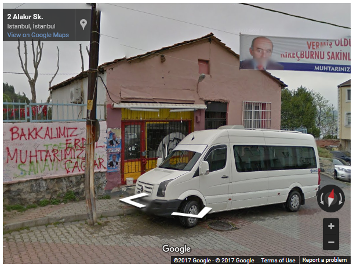
As previously pointed out, the digital ethnography of the “places of imagination” that are reflected by fans of Leyla ile Mecnun provide us with the evolution of places over the time. The most observable change in this sense is the filming location of the shop of Erdal the Grocer. As it is central to the other filming locations in Kirecburnu and was a fictionally commercial/branded place, the shop of Erdal the Grocer is the most popular venue of a Leyla ile Mecnun tour. Looking at the photographs taken there year-by-year, the building seems like abandoned. For example, a Street View photograph taken in April 2014 (Figure 1) shows that the branding has been removed after the filming ended, but the yellow and red colours of the façade remains the same as displayed in the series. However, an intense number of slogans about the series written by the fans are seen. Smaller writings with pencil over the façade are also noticeable.
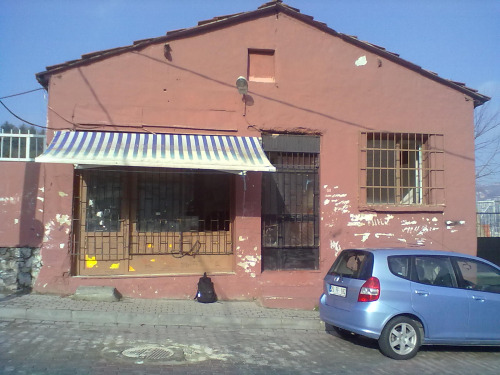
In a photo taken by a fan in June 2015[5] (Figure 2), the façade and the wall aside are painted probably in order to close the writings over. The colours are gone, and despite the opened tent, the shop looks more abandoned than before. Imperfection of the painting gives hints from the past as some yellow surface is seen below.
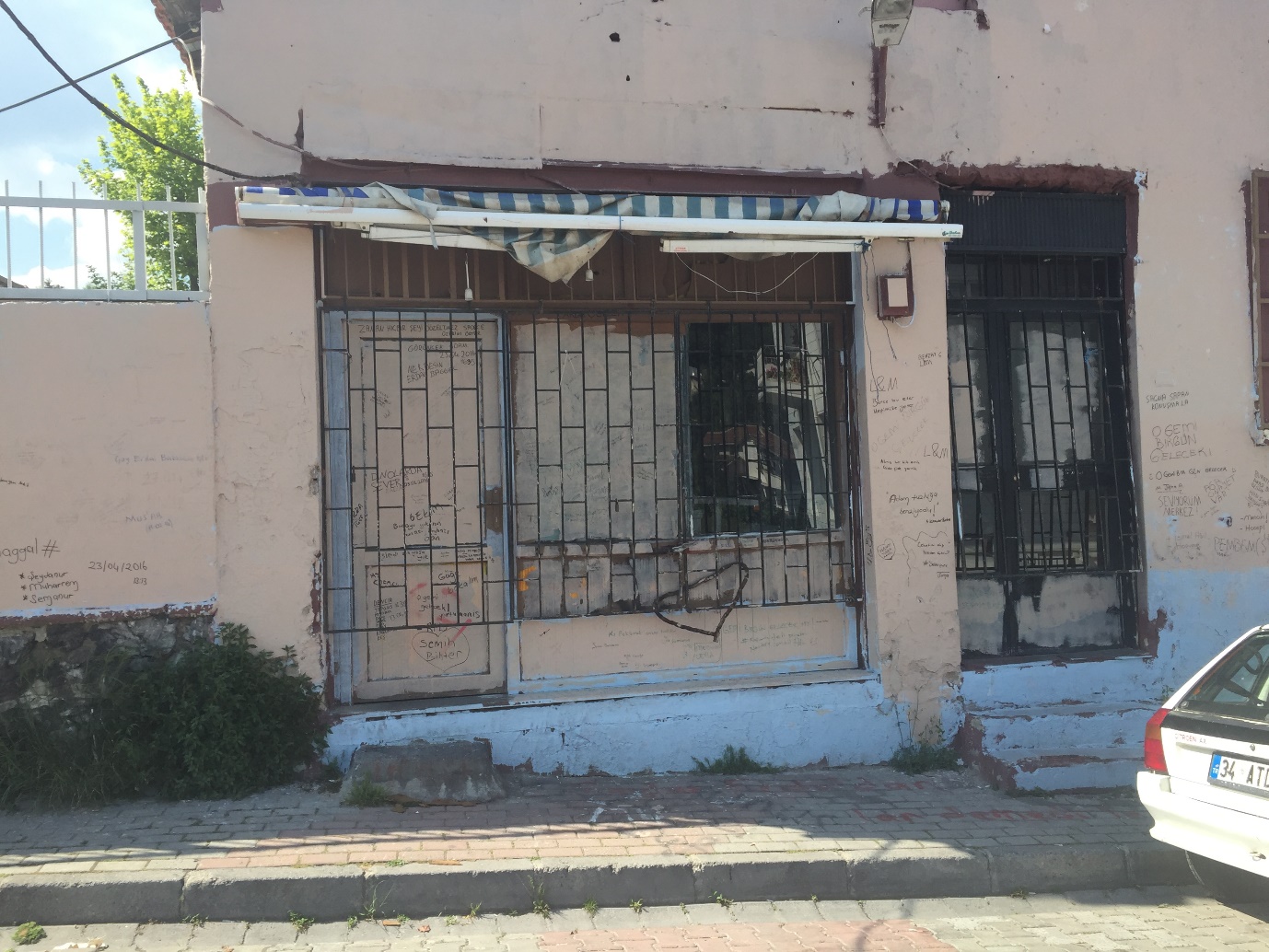
Finally, in another fan photo from April 2016 the shop is seen as painted again[6], this time sloppier and more brutal to an extent. Closing the writings over does not help, fans still fill the space with memorial texts from the series. However, they do not care about the aesthetics like 2 years ago, which goes in parallel with the painter, who even starts to paint the glasses.
Another popular place of the tour is Mecnun’s home. From the experiences told by fans in the blog posts and forum discussions, the current owner of the house is not pleased with the interest shown, probably having right to a degree[7]. A dog waits for the visitors in the garden to prevent them to get closer, contact with the owner (with a hope to drink tea and talk about the house and the interest), take photos, and perform other rituals. Thus, it has naturally become forbidden to visitors as it returned to its state of private property and thanks to being in the middle of a big and elevated garden. However, the house is also witnessed to host film shooting of another TV series, the crew of which is reported to behave harsh and unfriendly to one of a Leyla ile Mecnun “pilgrim”[8]. The fans have been surprised more when they came across a real estate advertisement of Mecnun’s home[9]. While the asked price was astronomic, the photos of the advertisement indicated that many rooms still remain with the same furniture, leading the fans to perceive as if a transmedia narrative is going on. It is unknown that price was asked whether for the fame of the series, or the priceless Bosporus view, however, it became obvious that film-induced tourism is not an option for the owner of the house.
Similar mindset is adopted by the responsible municipality, as it is permitted to demolish the café next to the shoreline in which the characters frequently meet and discuss about the important issues[10]. One of the pilgrimage places is completely lost. From the experiences of the fans who visited the café in order to recreate the dialogues in Leyla ile Mecnun that took place there, the café does not have a pleasant and friendly service[11]. This causes a disappointment over the fans, however, the place continues to have a significant meaning to them[12].
Conclusion
As the places play such an important role in the relationship between “Leyla ile Mecnun” and its fans, visits to these places have been occurred from time to time, starting during the filming of the series and continuing after its cancellation. While the visits before the cancellation were mostly for being witnesses to the filming set and possibly meeting with actors or the director, the visits, especially after cancellation, can be considered as media pilgrimage (in terms of the definitions discussed in Beeton 2005; Couldry 2003; Reijnders 2010) since there are the rituals and challenges involved, which is seen from the memoirs and photos published at blog posts and forum discussions.
I find this as a valuable case among the media pilgrimage discussions. Unlike such discussions which mostly focus on the commoditisation of the media site tours and the tourist behaviour in those sites, the case I tried to examine expands the topic to the opposite scenario: What if a filming site is not evaluated as part of film-induced tourism even though people still voluntarily and individually visit the neighbourhood in remembrance of the TV series? How do these visits matter if they are not part of any planned tour? The examples of media pilgrimage (such as Busby & Klug 2001; Reijnders 2010; Beeton 2005) mostly include a success story behind them, at least to some point before their probable decline. This case, instead, is a story of political inertia in which the potential is evident in the individual tours done by the fans themselves. I tried to claim this evidence of potential in this research by collecting and analysing the textual and visual material published by the fans.
Notes
[1] A small-scale content analysis made among the Google images results of “leyla ile mecnun tumblr”, with the criteria of having an image of any character(s) of the series and overlay texts. About half of the results have a melancholic theme, while the others represent the humorous lines.
[2] Kadın&Sanat. 2012. Haftasonu Gezmeleri, Leyla ile Mecnun Seti. [ONLINE] Available at: http://www.kadinsanat.net/haftasonu-gezmeleri-leyla-ile-mecnun-seti/. [Accessed 26 January 2017].
[3] simone. 2012. leyla mecnun ve kireçburnu . [ONLINE] Available at: http://simoneburada.blogspot.nl/2012/10/leyla-mecnun-ve-kirecburnu.html. [Accessed 23 January 2017].
[4] Leyla ile Mecnun Dizisi. 2012. Kireçburnu’nda Leyla ile Mecnun izdihamı. [ONLINE] Available at: http://www.leylailemecnundizisi.com/kirecburnunda-leyla-ile-mecnun-izdihami. [Accessed 25 January 2017].
[5] Donanım Haber Forum. 2015. Leyla ile Mecnun’un Çekildiği Yerler [SS’li] . [ONLINE] Available at: https://forum.donanimhaber.com/fb.asp?m=107341671. [Accessed 25 January 2017].
[6] Donanım Haber Forum. 2016. Leyla ile Mecnun’un Çekildiği Yerler [SS’li] . [ONLINE] Available at: https://forum.donanimhaber.com/fb.asp?m=116454791. [Accessed 25 January 2017].
[7] Donanım Haber Forum. 2014. Leyla ile Mecnun’un Çekildiği Yerler [SS’li] . [ONLINE] Available at: https://forum.donanimhaber.com/leyla-ile-mecnunun-cekildigi-yerler-ssli–91981657. [Accessed 25 January 2017].
[8] Donanım Haber Forum. 2015. Leyla İle Mecnun – Olaylı Kireçburnu ziyareti. [ONLINE] Available at: https://forum.donanimhaber.com/leyla-ile-mecnun-olayli-kirecburnu-ziyareti–101177428. [Accessed 25 January 2017].
[9] ekşi sözlük. 2016. leyla ile mecnun’daki evin 6 milyon usd olması. [ONLINE] Available at: https://eksisozluk.com/leyla-ile-mecnundaki-evin-6-milyon-usd-olmasi–5136447. [Accessed 26 January 2017].
[10] Donanım Haber Forum. 2014. Leyla ile Mecnun’un Çekildiği Yerler [SS’li] . [ONLINE] Available at: https://forum.donanimhaber.com/leyla-ile-mecnunun-cekildigi-yerler-ssli–91981657. [Accessed 25 January 2017].
[11] Yerler Kaymıyo Yalnız. 2017. evet ben bugün Kireçburnu’na gittim 😀 Ya burdan…. [ONLINE] Available at: http://ogemi.tumblr.com/post/74201207214/evet-ben-bugün-kireçburnuna-gittim-d-ya-burdan. [Accessed 26 January 2017].
[12] Şıpıdık Terlikler. 2013. Şıpıdık terlikler Kireçburnu’nda . [ONLINE] Available at: http://sipidikterlikler.blogspot.nl/2013/03/spdk-terlikler-kirecburnunda.html. [Accessed 25 January 2017].
References
Beeton, S., 2005. Film-induced Tourism illustrate., Channel View Publications.
Boylan, M.E., 2015. Humorists’ Narratives on Social Role of Humor in Turkey in a Historical Perspective. Middle East Technical University.
Busby, G. & Klug, J., 2001. Movie-induced tourism: The challenge of measurement and other issues. Journal of Vacation Marketing, 7(4), pp.316–332. Available at: http://jvm.sagepub.com/cgi/doi/10.1177/135676670100700403.
Couldry, N., 2003. Media Rituals: A Critical Approach, London, New York: Routledge.
Emre Cetin, K.B., 2014. The “politicization” of Turkish television dramas. International Journal of Communication, 2014(8), pp.2462–2483.
Jamal, T. & Robinson, M. eds., 2009. The SAGE Handbook of Tourism Studies, Los Angeles, London, New Delhi, Singapore: Sage.
Jenkins, H., Ford, S. & Green, J., 2013. Spreadable Culture: Creating Value and Meaning in a Networked Culture, New York, London: New York University Press.
Keskin, A., 2016. “Sevdigin dizi gun degistirsin”: Leyla ile Mecnun dizisindeki kargislarin (beddua) pragmatik analizi. Milli Folklor, (109), pp.44–57.
Long, P. & Robinson, M., 2009. Tourism, Popular Culture and the Media. In T. Jamal & M. Robinson, eds. The SAGE Handbook of Tourism Studies2. Los Angeles, London, New Delhi, Singapore: Sage, pp. 98–114.
Lukuslu, D., 2014. Leyla ile Mecnun: Absurd Comedy or a Cult TV Series of Youth Culture in Turkey? In TV-SERIES Turkey. Parıs.
Murthy, D., 2008. An Examination of the Use of New Technologies for Social Research. Sociology, Vol. 42(Special Issue on The Future of the Research Relationship), pp.837–855.
O’Reilly, K., 2005. Ethnographic Methods, London: Routledge.
Pink, S. et al., 2016. Digital Ethnography 1st ed., Los Angeles, London, New Delhi, Singapore, Washington DC: Sage.
Reijnders, S., 2010. Places of the imagination: an ethnography of the TV detective tour. Cultural Geographies, 17(1), pp.37–52. Available at: http://cgj.sagepub.com/cgi/doi/10.1177/1474474009349998.
Riley, R., Baker, D. & Van Doren, C.S., 1998. Movie induced tourism. Annals of Tourism Research, 25(4), pp.919–935.
Soylu, F., 2009. Designing Online Learning Communities: Lessons from Eksisozluk. European Journal of Open, Distance and E-Learning, p.Learning, 2009, Issue 2.
Varis, P., 2016. Digital Ethnography. In A. Georgakopoulou & T. Spilioti, eds. The Routledge Handbook of Language and Digital Communication. London, New York: Routledge, pp. 55–68.